HELP & INFORMATION
FREQUENTLY ASKED QUESTIONS
DO CHILDREN WITH DYSLEXIA NEED TO GO TO A SPECIAL SCHOOL?
WHAT IS THE DIFFERENCE BETWEEN ORTON-GILLINGHAM AND EBLI?
WHAT'S THE DIFFERENCE BETWEEN LINDAMOOD-BELL, WILSON, BARTON, AND ORTON-GILLINGHAM?
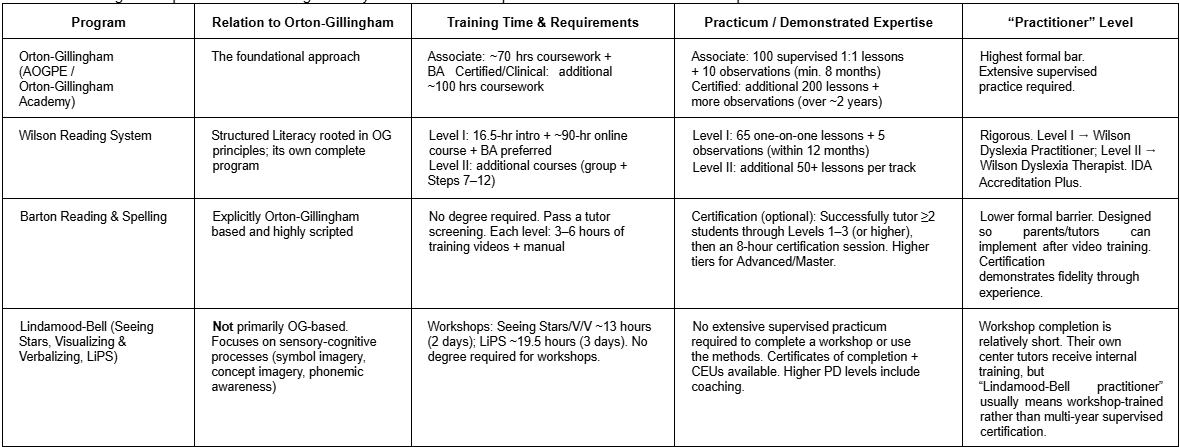
All of these approaches are designed to help struggling readers, but they differ in how flexible they are, how they’re taught, and how much training is required to use them well.
Orton-Gillingham is the foundational structured literacy approach. It is highly individualized and can be adapted to a child’s specific reading and spelling needs.
Wilson and Barton are more structured programs built from Orton-Gillingham principles. They follow a more defined sequence, with Barton in particular designed to be very scripted so parents and tutors can follow it step by step.
Lindamood-Bell takes a somewhat different approach, focusing more heavily on underlying reading processes such as sound awareness, symbol imagery, and comprehension.
Dyslexia Rescue draws on the strengths of structured literacy and Orton-Gillingham-based instruction, but goes beyond simply following a scripted program. The teaching is designed to help parents understand why their child is struggling, build the underlying literacy concepts they may have missed, and respond to the child in a more individualized way rather than forcing every learner through the exact same sequence.
The biggest difference is that Dyslexia Rescue is not just about completing lessons — it is about helping a child build a deeper understanding of how language and reading work, while giving parents the tools to support that learning consistently at home.
WHAT IF MY CHILD HAS READING DIFFICULTY DUE TO ADHD OR OTHER LEARNING CHALLENGES? CAN THEY BENEFIT FROM THE PROGRAM?
Yes. In fact, we also specialize in serving children with ADHD. Dyslexia and ADHD often overlap and coexist, along with other challenges, such as dysgraphia, autism and other forms of neurodivergence. While every child is different and no guarantees can ever be made, we have seen our Orton-Gillingham based Structured Literacy methods consistently change the lives of children with many different types of learning differences.
HOW LONG DOES IT TAKE TO COMPLETE THE PROGRAM?
While every child's needs are different, we see an average of about 8 - 14 months of attendance before program graduation.
DOES MY CHILD HAVE TO HAVE A DIAGNOSIS TO BE IN YOUR PROGRAM?
No. No diagnosis is necessary to take part in the Dyslexia Rescue program. We do our own comprehensive assessment of foundational literacy skills. This gives us the exact information we need. Beyond that, our instruction is diagnostic and prescriptive throughout every moment of every lesson. That means that our Structured Literacy expert with more than 25 years of experience, analyzes every response that your child makes and responds based upon that information. Every moment of every lesson is part assessment and part individualized prescriptive instruction. That is why our students make tremendous progress.
However, there are times when a neuropsychological evaluation and medical diagnosis is helpful or even necessary to have. For example, some schools require a medical diagnosis in order to access an IEP or 504, which can provide certain accommodations such as extended time on assignments or testing accommodations. Also, it can be helpful to have a medical/ neuropsychological diagnosis and IEP or 504 in place early, so that accommodations will follow the student for college/testing situations. In addition, when a child's behaviors are particularly complex or when they extend beyond reading and literacy skills, a neuropsychological evaluation can be helpful. We never discourage medical/neuropsychological evaluation and sometimes even recommend it. Such decisions always belong to the family.